






What is a GPU? Why is the GPU Indispensable for Artificial Intelligence?
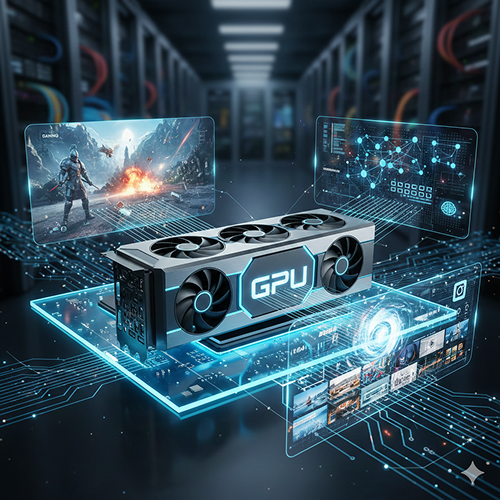
What is a GPU? A GPU (Graphics Processing Unit) is a specialized electronic circuit in your computer responsible for rendering images, animations, and videos. It is the core component of what is commonly known as a graphics card. The GPU’s primary function is its ability to perform parallel computing processing thousands of small tasks simultaneously and rapidly. This capability is critical for the following tasks.
Another answer to “What is a GPU?” lies in its capacity to process complex 3D environments, lighting, shadows, and textures in seconds to deliver a smooth experience. In graphic design and video editing, the GPU accelerates the handling of high-resolution images and video effects. In Artificial Intelligence and Machine Learning (AI/ML), it excels in compute-intensive tasks like matrix multiplications on large datasets, making it widely used in these fields.
Difference Between GPU and CPU
The GPU typically works alongside the CPU (Central Processing Unit), often called the computer’s brain, but their functions differ:
| Feature | CPU (Central Processing Unit) | GPU (Graphics Processing Unit) |
|---|---|---|
| Core Count (Individual) | Few (around 4–16), but very powerful | Thousands, but less powerful individually |
| Primary Task | General-purpose tasks, complex sequential operations | Graphics processing and parallel computing tasks |
| Processing Type | Focused on completing one task very quickly | Focused on completing thousands of small tasks simultaneously |
Types of GPUs
1-Integrated GPU (iGPU):
- Embedded within the CPU.
- Less powerful but energy-efficient.
- Sufficient for basic office work, web browsing, and light graphics tasks.
2-Discrete/External GPU (dGPU):
- Installed as a separate card on the motherboard (graphics card).
- Much more powerful with its own memory (VRAM).
- Used for high-performance gaming, professional design, and scientific computing.
GPU and Artificial Intelligence Applications
The GPU (Graphics Processing Unit) forms the foundational hardware infrastructure for modern Artificial Intelligence (AI) applications, particularly Deep Learning (large language models, image recognition, autonomous systems, etc.). The relationship between these fields stems from the GPU’s superior parallel computing architecture.
Why is the GPU Indispensable for AI?
Artificial intelligence, especially deep learning, involves intensive mathematical operations—particularly matrix multiplications and tensor operations—on massive datasets with millions or billions of parameters.
The key reasons why GPUs are critical for AI include:
1. Parallel Processing Power (Massively Parallel Architecture)
- Core Difference: While a CPU typically has a few powerful cores, a GPU features thousands of smaller, energy-efficient cores.
- Processing Type: In AI model training, the same computation (e.g., matrix multiplication) is applied repeatedly across different data segments. These repetitive, independent calculations can be executed simultaneously by the GPU’s thousands of cores, far faster than the CPU’s sequential processing.
2. Model Training and Inference Speed
- Training Time: Training AI models (e.g., GPT-4, DALL-E) on large datasets could take weeks or months on a CPU, but powerful GPU clusters reduce this to hours or days.
- Real-Time Inference: Once trained, GPUs enable instant results for end-users. For example, object recognition in autonomous vehicles or rapid responses from Large Language Models (LLMs) in conversations rely on GPUs.
3. Specialized Optimizations (Tensor Cores)
- Leading GPU manufacturers (especially NVIDIA) have added Tensor Cores to modern cards—specialized hardware units designed exclusively to accelerate AI and deep learning computations. These provide an additional layer of performance boost for AI workloads.
The key reasons why GPUs are critical for AI include:
| Application Area | GPU’s Role |
|---|---|
| Large Language Models (LLMs) | High-speed training and real-time text generation for billions of parameters (e.g., ChatGPT, Gemini). |
| Image / Video Processing | Image recognition, face detection, object tracking, and AI-generated visuals (e.g., DALL·E, Midjourney). |
| Autonomous Systems | Real-time sensor data processing and decision-making in self-driving cars and robots. |
| Healthcare | Accelerated analysis of medical images (MRI, X-rays) and cancer diagnosis. |
| Scientific Computing | High-Performance Computing (HPC) tasks like climate modeling and subatomic particle simulations. |