






What Is SD-WAN? Why SD-WAN Monitoring Is Matters?
SD-WAN (Software-Defined Wide Area Network) is a modern networking technology that introduces a software-driven approach to managing wide area networks (WAN). In traditional WAN architectures, traffic-routing decisions are manually configured on individual network devices (routers). SD-WAN centralizes and automates these decisions through a software-based control layer. Therefore, effective SD-WAN monitoring is essential to maintain service quality, detect performance bottlenecks, and ensure business-critical applications operate without disruption.
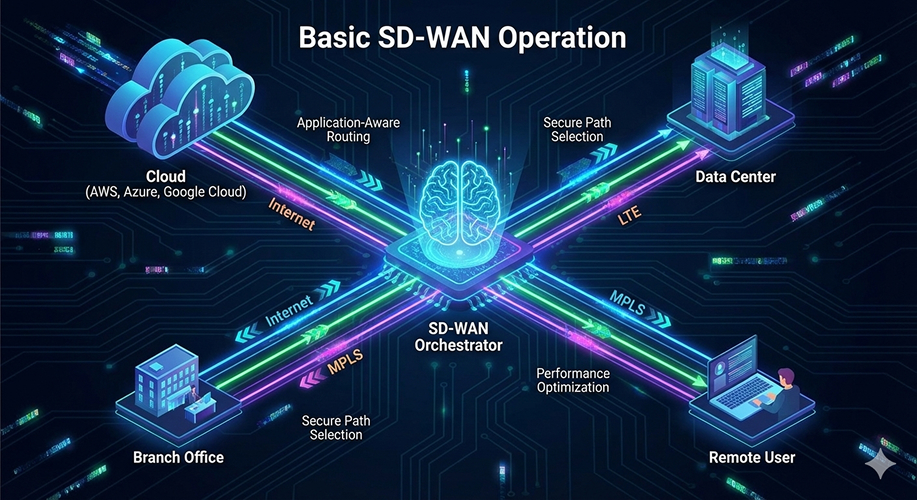
SD-WAN monitoring is essential to ensure consistent application performance and uninterrupted business operations across distributed networks. While SD-WAN dynamically optimizes traffic paths, visibility into real-time network conditions, application behavior, and link performance is critical to validate these decisions. Effective SD-WAN monitoring enables IT teams to proactively detect latency, packet loss, and jitter issues, quickly identify the root cause of performance degradation—whether related to service providers, network infrastructure, or applications—and enforce SLA compliance. By delivering end-to-end visibility and actionable insights, SD-WAN monitoring transforms the network from a reactive cost center into a measurable, controllable, and business-aligned service.
Where Does SD-WAN Sit in the OSI Model?
SD-WAN has a hybrid positioning within the OSI model and is typically explained through two layers:
- Network Layer (Layer 3):
SD-WAN is fundamentally anoverlay technology. It creates IP-based virtual tunnels (such as IPsec or GRE) on top of existing physical network links (the underlay). For this reason, it primarily operates at Layer 3. - Application Layer (Layer 7):
What makes SD-WAN “intelligent” is its ability to understand application traffic. Unlike traditional routers that rely solely on IP addresses, SD-WAN can identify the nature of the traffic itself (e.g., Zoom, SAP, or social media). This Application Awareness enables SD-WAN to make traffic-routing decisions at the application layer.
Which Business Services Are Affected by SD-WAN Problems?
Since SD-WAN sits at the center of the enterprise network, any performance degradation (latency, packet loss) or outage directly impacts digital business operations.
| Affected Business Service | Impact of the Problem |
|---|---|
| Voice and Video Communication (VoIP, Teams, Zoom) | These are the most sensitive services. Increased latency causes voice distortion, dropped calls, and frozen video, making meetings ineffective or impossible. |
| Cloud (SaaS) Applications (M365, Salesforce, SAP) | File uploads and downloads slow down, screens freeze, and access to cloud-based data is impaired, directly reducing employee productivity. |
| Financial Transactions and POS Systems | Payment systems at branches or retail locations become slow or experience timeouts, leading to customer dissatisfaction and revenue loss. |
| Data Center Access (ERP, CRM) | Loss of access to core enterprise systems can bring operations to a complete standstill. |
| Security Services | Disruptions to firewall or VPN services delivered via SD-WAN expose the network to cybersecurity risks. |
Why Is SD-WAN Monitoring Critical?
Although SD-WAN is inherently “smart,” identifying the root cause of an issue—whether it originates from the service provider (e.g., telecom operators), the network device, or the application itself—can be challenging without proper monitoring.
SD-WAN Monitoring tools provide clear, actionable insights such as:
“Critical SAP traffic is currently being routed over a 4G link due to MPLS degradation, which explains the perceived performance slowdown.”
SD-WAN monitoring solutions deliver the following key benefits:
- End-to-End Visibility: Real-time insight into which physical links (MPLS, fiber, 4G/5G) and which virtual tunnels traffic is using.
- Performance Analysis and SLA Monitoring: Continuous tracking of key metrics such as latency, jitter, and packet loss to validate service provider SLA commitments.
- Traffic Steering Intelligence: Clear visibility into why SD-WAN devices choose specific paths—for example, why voice traffic is routed over Internet instead of MPLS.
- Rapid Root Cause Analysis: Immediate identification of whether an issue is caused by the service provider, hardware failure, or configuration error.
Which Critical Applications Run on SD-WAN?
Thanks to Application Awareness, SD-WAN can classify and prioritize traffic based on business importance. Organizations therefore run their most sensitive and bandwidth-intensive applications over SD-WAN to ensure continuity of operations.
These critical applications can typically be grouped into four main categories:
1. Real-Time Communication Applications (UCaaS)
These applications are extremely sensitive to latency and packet loss. Even minor network fluctuations can degrade user experience.
- VoIP (IP Telephony): Enterprise voice systems
- Video Conferencing: Microsoft Teams, Zoom, Cisco Webex, Google Meet
- Call Center Platforms: Customer support and contact center solutions
2. Cloud-Based Productivity Tools (SaaS)
Most enterprise data now resides in the public cloud. SD-WAN improves performance by enabling local internet breakout, bypassing unnecessary backhauling to the data center.
- Microsoft 365: Outlook, SharePoint, OneDrive
- CRM and Sales Platforms: Salesforce, Microsoft Dynamics
- File Sharing: Dropbox Business, Box
3. Enterprise Resource Planning and Finance (ERP/CRM)
These systems represent the operational core of the organization. Any slowdown can halt manufacturing, logistics, or sales operations.
- ERP Systems: SAP (especially SAP S/4HANA Cloud), Oracle NetSuite
- Financial Transactions: Banking systems, POS terminals, ATM connectivity
- Inventory Management: Warehouse and logistics applications
4. Cloud Infrastructure and Database Access (IaaS)
- Cloud Platforms: Virtual machines hosted on AWS, Microsoft Azure, and Google Cloud Platform (GCP)
- Databases: SQL servers and large-scale data warehouses