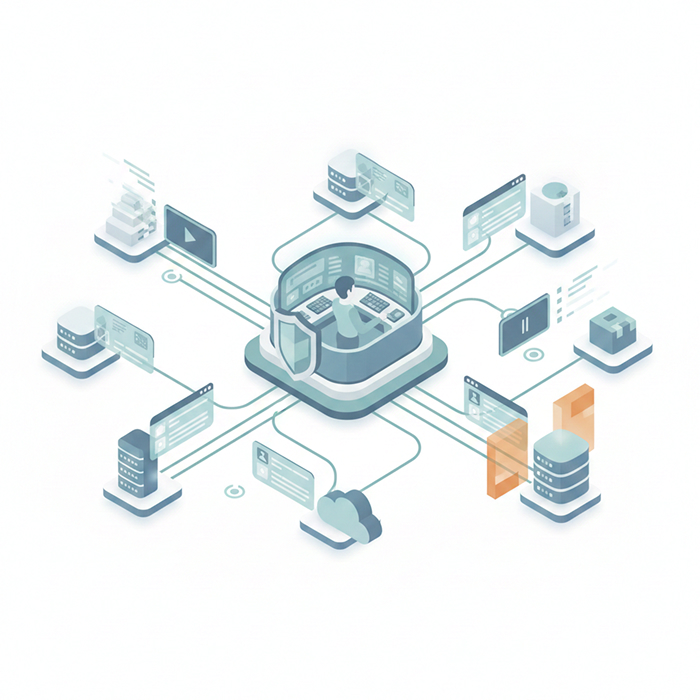




Privileged Access Management

Privileged
Access Management (PAM)

Privileged Access Management is a strategic security layer that protects an organization’s most critical assets. Reduces the risk of unauthorized access, limits internal threats, facilitates compliance with laws and regulations, and significantly mitigates the impact of cyberattacks.


What is Privileged Access Management?

Privileged Access Management (PAM) is a critical cybersecurity layer that enables organizations to securely, centrally, and audibly manage access to accounts with the highest levels of privilege. Privileged accounts (such as system, network, and database administrators, as well as application and service accounts) have broad access to servers, network devices, databases, and mission-critical systems, making them prime targets for cyberattacks. PAM solutions are designed to prevent misuse of these high-risk accounts, enforce least-privilege access, record and monitor all privileged activities, and provide real-time response capabilities when needed. As a result, organizations can better protect their critical assets, strengthen their security posture, and meet compliance requirements.

ayrıcalıklı erişim yönetimi, kron teknoloji, privileged access management,

Who Can Access
Privileged Accounts, When, and How

PAM solutions ensure that privileged account passwords are securely stored in a central vault and automatically changed on a regular basis. This means that passwords are never directly known, shared, or manually managed by any user. When users wish to access the system, they authenticate via PAM and only gain access to the systems they are authorised for, within the defined time and scope. This approach implements the “least privilege” principle, ensuring that users only have the minimum privileges required to perform their jobs.

How to Monitor, Record, and Instantly Take Control of Privileged Sessions?

Privileged Access Management also offers session management and recording capabilities. This means that all actions performed with privileged accounts are recorded in video or log format, allowing clear visibility into who accessed which system, when, and for what purpose. In the event of a potential security breach, error, or misuse, root cause analysis can be performed and audit processes are simplified. Furthermore, risky or suspicious behaviour can be detected in real time, allowing the session to be automatically terminated.

ayrıcalıklı erişim yönetimi, kron teknoloji, privileged access management,

How Does It Work in Privileged Access Management (PAM)?

Password Vaulting & Rotation

Securely store all privileged credentials for critical systems in a centralized vault. Automated password rotation keeps credentials up to date, minimizing security risks and strengthening enterprise access security.

Continuous Session Recording

Monitor all privileged user sessions in real time and record every activity with high fidelity. Ensure end-to-end session visibility and maintain compliance with audit and regulatory requirements.

Secure & Controlled Privileged Access

Enable users to securely connect to critical systems while maintaining full control over access. Enforce Multi-Factor Authentication (MFA) and passwordless authentication to strengthen identity verification and secure every access point.

Just-in-Time (JIT) Privilege Elevation

Eliminate the risks associated with standing administrative privileges. Grant users elevated permissions only when needed and for a limited period, minimizing the attack surface and enforcing least-privilege access.

Unauthorized Activity Detection

Continuously analyze privileged user behavior using AI-powered analytics. Detect suspicious activities and unauthorized actions in real time, enabling security teams to mitigate threats before they escalate.


Live Session Monitoring

Allow security administrators to join active sessions in real time, monitor suspicious activities as they happen, and terminate sessions immediately when necessary.


Privileged Access Management

A Next-Generation Approach to
Privileged Access Security

Identity Security & Vault Management

Go beyond traditional solutions by managing critical password vaults and automated rotation processes end-to-end, in line with the highest security standards.

Session Monitoring & Real-Time Intervention

Monitor and record all privileged sessions in real time, ensuring complete visibility and control. Detect suspicious activities and intervene immediately through administrator oversight.

Dynamic Privileges & Threat Detection

Replace permanent privileges with just-in-time access. Integrate IAM, PAM, MFA, and ITDR layers to establish a continuous, risk-based security framework.

Privileged Access Management

Key Benefits Provided
Our PAM Solutions

Unified PAM Platform

Centralizes privileged access across multiple systems within a single platform.


Centralized Password Management

Provides a secure, centralized password vault that prevents unauthorized password sharing.

Multi-Factor Authentication

Adds an extra layer of security beyond passwords through MFA support.


Unified Access Management

Centrally controls access to network devices and servers, ensuring consistent security policies.

Database Access Management

Monitors and audits database administrators’ sessions without requiring agents on target systems.

Privileged Task Automation

Automates routine system administration tasks, reducing human error and improving operational efficiency.

Privileged Session Control

Detects and prevents malicious activities by monitoring and recording privileged sessions in real time.

F.A.Q

Frequently Asked Questions

01

What is Privileged Access Management (PAM) and why is it important?

Privileged Access Management (PAM) is a specialized cybersecurity strategy that secures, controls, and monitors accounts with elevated permissions, such as administrator, root, and service accounts. Because these accounts hold unrestricted access to mission-critical servers, databases, and network devices, they are the primary targets of cyberattacks. ODYA PAM solutions mitigate these risks by vaulting credentials, enforcing least-privilege access, and recording all privileged sessions.

02

What is the relationship between PAM and 2FA / MFA?

While 2FA and Multi-Factor Authentication (MFA) focus on verifying user identity through multiple authentication factors, PAM is an overarching governance framework that integrates MFA as a core security layer. Within a PAM architecture, users must complete MFA verification before accessing credential vaults or initiating privileged sessions. In short, MFA serves as the identity checkpoint, while PAM provides end-to-end credential rotation, privilege elevation, and session auditing.

To explore authentication fundamentals further, check our guide on What is Two-Factor Authentication (2FA).
03

What is the difference between IAM and PAM?

Identity and Access Management (IAM) governs general user identities and standard access rights across an organization’s workforce. Privileged Access Management (PAM) specifically isolates, secures, and audits accounts with high-level administrative control over core IT infrastructure. While IAM manages who gets into the building, PAM controls who holds the master keys to the data center and critical systems.

04

How do “Least Privilege” and “Just-in-Time” (JIT) access work in PAM?

Static, always-on administrative privileges create massive security vulnerabilities. Modern PAM eliminates standing privileges by granting users elevated permissions strictly on an as-needed, time-bound basis (Just-in-Time). Once the authorized maintenance window or task is completed, privileges are automatically revoked, drastically reducing the attack surface.

05

How are privileged sessions monitored, recorded, and controlled in real time?

PAM platforms record all privileged sessions—including SSH, RDP, SQL, and web connections—in searchable log and video formats for complete forensic visibility. Powered by AI-driven behavioral analytics, the system detects anomalous commands or unauthorized actions in real time, allowing security teams to monitor sessions live or automatically terminate suspicious connections before damage occurs.

06

How does PAM support regulatory compliance (ISO 27001, GDPR, PCI-DSS)?

Global compliance frameworks such as ISO 27001, GDPR, HIPAA, and PCI-DSS require strict accountability and audit trails for access to sensitive data. ODYA PAM eliminates shared administrative passwords, enforces individual accountability, and generates tamper-proof session logs, turning complex compliance audits into streamlined, automated reporting processes.

07

Does implementing ODYA PAM disrupt existing IT workflows or user tools?

Not at all. ODYA Technology’s PAM solution deploys up to 80% faster than traditional alternatives without disrupting daily operations. System and database administrators can continue using their preferred local clients—such as PuTTY, RDP, SecureCRT, or TOAD—while PAM operates transparently in the background to secure and log every session.

ODYA Technology

Let’s Talk With
Our Experts

From IT to the field, discover the end-to-end monitoring and seamless control solutions you need—straight from our team!

    Your information will be securely sent to and stored in Google Sheets for the purpose of processing your form submission.
    İletişim, ODYA Teknoloj, Contact us, ODYA Contact

    +90 216 577 5320

    info@odya.com.tr

    Headquarters

    Barbaros Mah. Begonya Sok. No: 3 NİDA Kule Kuzey Kat: 12 Ofis:133, 34746 Ataşehir/İstanbul

    R&D Center

    BİRUNİ Teknopark – Kazlıçeşme Mah. 245.Sok. No:5 Zeytinburnu/İstanbul

      Your information will be securely sent to and stored in Google Sheets for the purpose of processing your form submission.
      Contact Us