






Why Do Network Inventory and IT Inventory Not Match?
As enterprise networks grow, IT teams increasingly struggle to answer one fundamental question: “Which devices are actually on our network right now?” Modern enterprise networks are no longer limited to servers, switches, and firewalls. Laptops, mobile devices, IoT equipment, OT systems, and temporary connections have transformed network topologies into living, constantly changing ecosystems. This dynamic structure makes maintaining a complete and up-to-date network inventory more critical than ever. Yet in practice, true visibility remains a major challenge for many organizations.
How is network inventory validated?
How is it continuously tracked?
The answers lie in the rest of this article.

Common Challenges in Network Inventory Management
Across enterprise network management projects, recurring challenges emerge—most of them rooted in deficiencies in network inventory management:
- Shadow IT: A portion of connected devices exists outside any inventory or CMDB system.
- Inconsistent inventory data: Information from different sources (ITSM tools, manual lists, network platforms) does not align.
- Delayed change detection: Newly added or removed devices are identified too late.
- Limitations of manual processes: Manually maintained inventories are error-prone and unsustainable.
These issues result not only in operational inefficiencies, but also lead to:
- Security vulnerabilities
- Compliance and audit risks
- Extended incident response times
At the core of the problem lies a simple reality:
There is no single, reliable, and authoritative answer to the question “What exists on the network?”
Why Is the Network Access Registry (NAR) Approach Necessary?
Traditional inventory solutions are largely declarative:
If someone enters a device into the system, it exists.
If not, it does not.
Networks, however, are not declarative—they are real-time and behavior-driven.
This is where the Network Access Registry (NAR) approach becomes essential.
Rather than being just another inventory system, Network Access Registry is a conceptual framework that manages the gap between network reality and recorded inventory data.
Its objectives are:
- Taking the network itself as the reference point
- Continuously comparing recorded inventories against this reality
- Making inconsistencies visible and actionable
What Is a Network Access Registry?
SPIDYA Network Access Registry (NAR) is a solution that automatically discovers devices connected to the corporate network, compares this data with existing inventory and CMDB systems, and manages the resulting discrepancies.
Key differentiators of SPIDYA Network Access Registry include:
- Vendor- and product-agnostic architecture
- Seamless integration on top of existing infrastructure and ITSM/CMDB tools
- Value creation without disrupting current investments
How Does SPIDYA Network Access Registry Work?
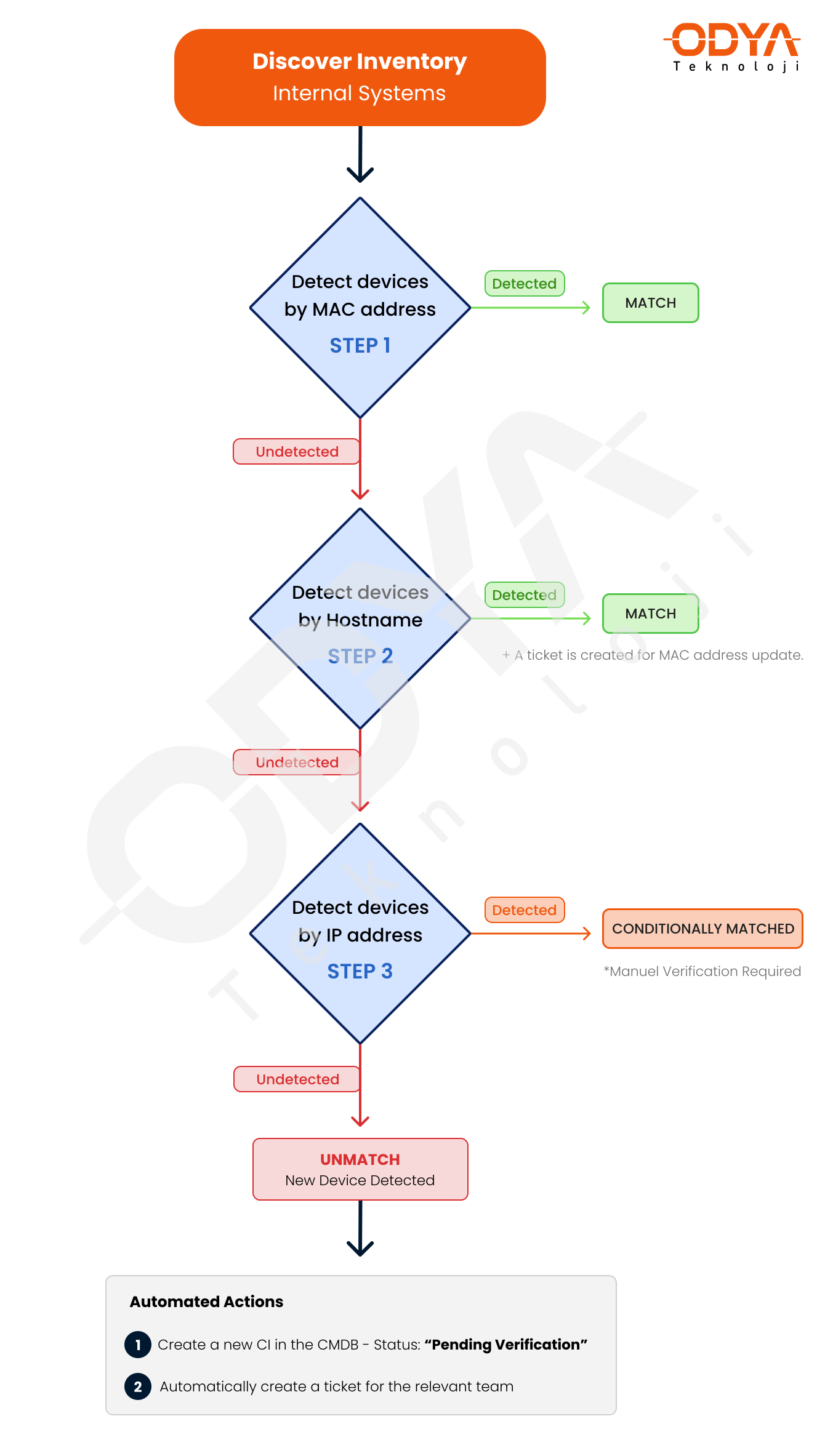
At a high level, SPIDYA NAR operates through four core stages:
1. Collect – Discover Network Reality
Active devices on the network are automatically detected. The focus is not on theoretical records, but on assets that are actually connected.
2. Normalize – Create a Common Language
Data from multiple sources (inventory systems, CMDBs, network tools) is normalized into a unified logical model, preventing duplicate or inconsistent representations of the same device.
3. Compare – Expose the Gaps
Discovered network assets are compared with recorded inventory data to clearly identify:
- Assets listed in inventory but absent from the network
- Assets present on the network but missing from inventory
- Records with mismatched or incomplete information
4. Act – Turn Visibility into Value
Detected inconsistencies do not remain passive reports. Based on organizational workflows, they can:
- Be reported
- Trigger CMDB record creation
- Initiate tickets or task workflows
As a result, a technical discrepancy becomes a manageable operational process.
What Does Network Access Registry Deliver?
The value of SPIDYA NAR extends well beyond inventory accuracy:
- Visibility into Shadow IT
- A trusted data source for audits and regulatory compliance
- A reliable starting point for incident management and root cause analysis
- Reduced manual inventory workload
- A smaller and clearer attack surface for security teams
Most importantly, network management is driven by real-time facts, not assumptions.
Network Inventory Management Is About Managing a Process, Not a List
In modern enterprise networks, inventory management is no longer about maintaining static lists. In a constantly changing environment, inventory accuracy must be continuously validated.
SPIDYA Network Access Registry is designed precisely for this need:
it takes the network as the source of truth and makes inconsistencies visible and actionable.