






What is an Outsource NOC Service?
As digital infrastructures grow increasingly complex, continuity, speed, and predictability in IT operations have become critical. At this point, an outsource NOC enables organizations to manage monitoring and operational processes end-to-end through an expert team.
The outsource NOC approach goes beyond simple alert monitoring; it encompasses correlation, incident response, automation, and continuous improvement disciplines within a holistic operational framework.
When Should You Consider an Outsource NOC Service?
Adopting an outsource NOC model is generally less about a technical choice and more about operational maturity, cost structure, and risk management. The following scenarios indicate the strongest signals (pain points) for considering NOC outsourcing:
24/7 Operations Are Not Achievable
Pain points:
- Limited or no night/weekend monitoring
- Critical alerts are detected too late
- On-call model becomes unsustainable
Why NOC Outsourcing?
Continuous monitoring and response capabilities can be deployed quickly, reducing operational risk.
Alarm Fatigue and Alert Blindness
Pain points:
- Excessive false positive alerts
- Critical incidents lost in noise
- Teams become desensitized to alerts
Why NOC Outsourcing?
Correlation, filtering, and pattern analysis ensure that only actionable incidents are prioritized.
Long MTTR (Mean Time to Resolution)
Pain points:
- Incidents take too long to resolve
- Escalation processes are unclear
- No post-incident RCA (Root Cause Analysis)
Why NOC Outsourcing?
Standardized incident management and runbook-guided responses accelerate remediation and reduce resolution times.
Internal Teams Overloaded
Pain points:
- IT teams constantly firefighting
- No time for strategic projects
- Burnout and staff turnover increasing
Why NOC Outsourcing?
Operational load is transferred externally, freeing internal teams to focus on transformation and innovation.
High Costs for NOC Setup and Operations
Pain points:
- Shift scheduling and staffing costs
- Difficulty finding specialized personnel
- Licensing and integration expenses
Why NOC Outsourcing?
Shifts CapEx to predictable OpEx, lowering total cost of ownership.
Non-Standardized Operational Processes
Pain points:
- Incident management depends on individuals
- Missing documentation or runbooks
- SLA measurement unavailable
Why NOC Outsourcing?
ITIL-aligned processes and measurable KPIs are implemented.
Rapid Growth or New Locations
Pain points:
- Monitoring new systems is delayed
- Capacity planning is challenging
- Operations cannot scale efficiently
Why NOC Outsourcing?
Flexible capacity allows operations to scale quickly.
Increased Business Continuity and SLA Pressure
Pain points:
- Customer SLA breaches
- Regulatory or audit pressure
- Outages directly affecting revenue
Why NOC Outsourcing?
Proactive monitoring and incident prevention strengthen service continuity.
Operational Maturity and Risk Management Make Outsource NOC Essential
Pain points:
In today’s competitive landscape, where digital service continuity is a business differentiator, outsource NOC is not just an operational model but a strategic transformation tool.
A well-designed NOC outsourcing strategy:
- Reduces operational risks
- Improves service quality
- Allows IT teams to focus on business value
For organizations, the question “Who will manage the NOC?” is no longer a technical decision—it is a strategic business choice.
What ODYA Teknoloji Offers in Outsource NOC Services
Monitoring and Correlation (24/7)
At the core of our service is continuous 24/7 monitoring:
- 24/7 infrastructure and service monitoring
- Alert correlation and consolidation
- Noise reduction
- Pattern analysis and anomaly detection
- Prioritization before users are impacted
The goal is not simply generating alerts but producing meaningful, actionable incidents. This prevents alert fatigue and significantly reduces MTTR.
Incident Response
Incident management is executed with clear discipline:
- Defined severity levels (Severity Matrix)
- Standard escalation procedures
- Clear communication channels
- Step-by-step guidance from initial alert to verified resolution
Each incident is treated not just as a technical record, but as an event with business impact, ensuring transparency between IT and business units.
Action Sets (Runbook & Automation Logic)
Incidents are handled based on predefined action sets rather than manual reflexes:
- “If X incident occurs, perform Y action” logic
- Runbook-based response
- Automatic or semi-automatic actions
- Repeatable and standardized operations
This approach removes person-dependency from operations and elevates organizational maturity.
Change and Maintenance Window Management
Planned activities are handled carefully to avoid unplanned outages:
- Planning maintenance windows
- Notifying relevant stakeholders
- Temporary rule and threshold adjustments in monitoring systems
- Risk mitigation measures
The goal: ensure “planned work” does not become “planned downtime” while maintaining service continuity.
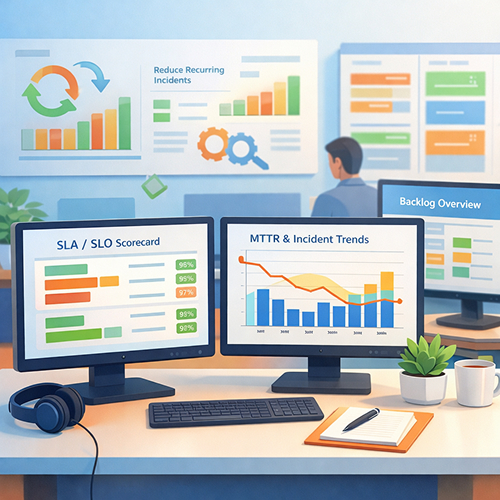
Reporting and Continuous Improvement
Our discipline goes beyond operations, incorporating data-driven improvement:
- SLA/SLO scorecards
- MTTR and incident trend analysis
- RCA summaries
- Recommendations to reduce recurring incidents
- Visibility into backlogs and operational load
This transforms IT operations from a reactive structure into a measurable and optimizable system.
Considering an Outsource NOC Service?
Fill out our form and get in touch. Let’s analyze your processes and bottlenecks together, and design the most suitable NOC operation model for your organization!