






Fragmented Ticketing Systems: How Can the Insurance Sector Deal with That?
The insurance sector does not operate through a structure where headquarters simply manages its own operations. Instead, it is responsible for coordinating a complex service ecosystem consisting of agencies, regional offices, sales branches, and customer service centers. This highly distributed operating model often creates fragmented ticketing, as each unit serves different customer segments, follows distinct operational workflows, and generates support requests through different platforms and processes.
This decentralized environment often results in fragmented ticketing, where incidents and service requests are scattered across multiple systems instead of being managed through a single, centralized platform.
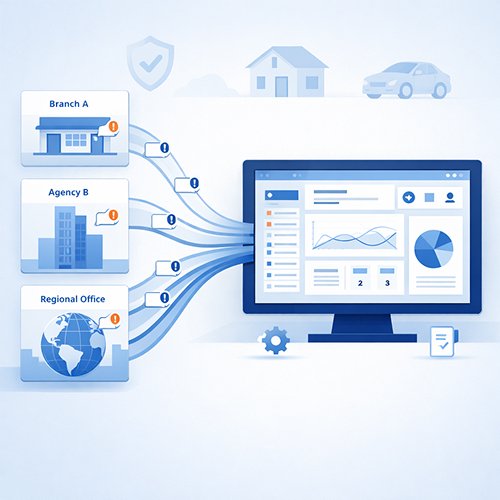
Ticket Creation from Multiple Sources
One of the biggest challenges in managing such an extensive network is fragmented ticketing systems. When requests originating from multiple channels and different software tools are not consolidated into a centralized structure, organizations lose end-to-end visibility, response times increase, priorities become inconsistent, and serious operational bottlenecks emerge.
Requests are often recorded in different systems by various departments or locations, creating a fragmented ticketing environment. One agency may use its own platform, while another region may create tickets through a modern ITSM tool or an older legacy system.
As a result, central operations teams are forced to track requests coming simultaneously from multiple sources and in different formats.
This situation not only complicates monitoring and resolution processes but also increases workload, leads to incorrect prioritization, and reduces operational efficiency. Fragmented ticketing prevents organizations from maintaining a unified view of incidents, and when tickets are not consolidated within a centralized system, even a small disruption can cause system-wide delays and a decline in service quality.
At this point, centralized ticket and monitoring management becomes a critical solution for insurance companies, enabling them to reduce operational complexity while improving both customer and agency satisfaction.
Each agency or region may open support requests within its own system. For example:
- An agency may create a support request through a claims management platform.
- Another region may use a different ticketing system for network or IT issues.
This decentralized approach creates fragmented ticketing, making it difficult for central teams to track requests arriving in different formats and systems while ensuring consistent service levels across the organization.
Fragmented Ticketing and Lack of Standardization
Because the insurance sector often operates with both legacy systems and modern ITSM (IT Service Management) structures, operational processes tend to exist within what can be described as a “hybrid chaos.”
This lack of standardization is not only a technical challenge; it is a business problem that directly affects customer satisfaction and profitability.
The main issues created by fragmented ticketing systems and lack of standardization can be summarized as follows:
- Data Silos and Loss of Visibility: When systems cannot communicate with each other, centralized monitoring becomes nearly impossible. As a result, strategic decisions are often based on assumptions rather than reliable data.
- Operational Inefficiency: Teams constantly switch between systems and manually transfer data. This increases time loss and the risk of human error.
- Unmeasurable Service Quality (SLA): Tracking resolution times end-to-end across different systems and formats becomes difficult. Maintaining consistent service levels for agencies and customers becomes nearly impossible.
- Audit and Compliance Risks: Regulatory requirements (such as financial or data protection regulations) demand traceability. Proving the full lifecycle of a request during audits can quickly turn into chaos.
- Barriers to Growth and Agility: When new agencies or products need to be integrated, existing complexity slows down growth and makes it harder for companies to adapt to new business models.
Traceability Issues and Duplicate Requests
The same problem may generate multiple tickets across different systems.
- Duplicate Workload and Resource Waste: Multiple records for the same issue can cause teams to work on the same problem without being aware of each other’s efforts, resulting in significant loss of productivity.
- Conflicting Resolutions: Different teams may attempt to resolve the same issue using different methods, potentially causing inconsistencies or further complications.
- Responsibility Confusion: It becomes unclear which system or team truly “owns” the request. This lack of ownership can delay resolution of critical issues.
- Data and Reporting Pollution: A single incident may appear as multiple problems in reports, leading to inaccurate incident frequency data and misleading root cause analyses.
Operational Inefficiency and Cost Impact in the Insurance Sector
- Managing multiple systems requires more workforce.
- The risk of incorrect prioritization or delayed intervention increases.
- Service quality declines, negatively affecting both agency and customer satisfaction.
The Solution: Centralizing Ticket and Monitoring Management
Consolidating fragmented systems within a single centralized structure significantly improves operational efficiency. When scattered systems are unified on a single platform, insurance operations can move from a reactive model to a proactive one.
Unified Visibility for the Insurance Sector (Single Pane of Glass)
Monitoring the health of the entire agency and regional network from a single screen eliminates operational blind spots. Every request becomes visible to the central team, regardless of its origin.
Institutionalized Service Management
Prioritization and SLA management are no longer dependent on individual systems but instead governed by corporate standards. This ensures consistent and measurable service quality for all stakeholders.
From Duplication to Efficiency
Through intelligent integrations, duplicate requests are automatically identified and eliminated. Teams avoid repeatedly working on the same issue, allowing human resources to focus on the most critical tasks.
Data-Driven Agility
When analysis and reporting processes are automated, organizations do more than just resolve incidents—they accelerate continuous improvement based on real data. This helps companies proactively address future operational bottlenecks.
By eliminating fragmented ticketing through a centralized monitoring and ticket ecosystem, organizations reduce operational noise and enable technology teams to focus on creating value instead of constantly firefighting incidents.
Centralized Control with ODYA Automated NOC
This is exactly where ODYA Automated NOC comes into play.
- All tickets and monitoring data from different agencies, regional offices, and locations are consolidated in a single central platform.
- Alerts and incidents are automatically converted into tickets, initiating ITSM processes without requiring manual intervention.
- Operations teams can manage everything from a single screen, eliminating the complexity of fragmented systems.
With ODYA Automated NOC, insurance companies increase operational efficiency while improving service quality. Instead of dealing with fragmented systems, they gain a centralized, integrated, and automated operational structure where processes remain fully under control.