






What Are Energy Sector Software Solutions?
A Digital Transformation Guide from Generation to Distribution
The energy industry operates across a highly complex value chain—from power generation and transmission to distribution and end-user services. Ensuring sustainability, operational efficiency, and service continuity across this ecosystem requires advanced digital capabilities. Today, energy sector software solutions are no longer optional IT investments; they are strategic enablers of resilience, competitiveness, and long-term growth.
In this guide, we explore why digital transformation is critical in the energy sector, the core categories of software solutions, and how energy companies can create measurable business impact through technology.
Why Digital Transformation Is Critical in the Energy Sector
The energy sector is classified as critical infrastructure. Even minor operational disruptions can lead to large-scale service outages, financial losses, regulatory penalties, and reputational damage.
Digital transformation strengthens operational resilience while improving visibility and decision-making capabilities.
Key Benefits of Digitalization
Service Continuity
Proactive IT infrastructure monitoring prevents outages and ensures uninterrupted energy production and distribution.
Operational & Maintenance Optimization
Software-driven workflows enhance predictive maintenance planning and significantly reduce unplanned downtime.
Risk & Security Management
Real-time monitoring of critical systems minimizes failure risks and strengthens cybersecurity posture.
Core Categories of Energy Sector Software Solutions
Energy organizations typically structure their digital transformation strategy around the following solution domains:
1. IT Operations Monitoring & Observability
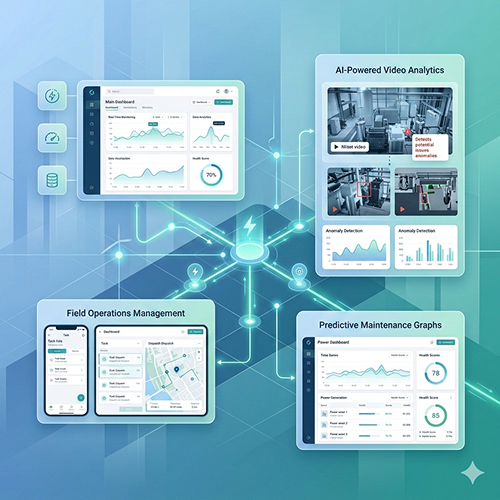
Energy infrastructures consist of multi-layered environments including networks, servers, applications, and service dependencies. Monitoring and observability platforms provide 24/7 visibility into system performance.
These solutions typically include:
- Infrastructure and network monitoring
- Application performance monitoring (APM)
- Real-time alerting and dashboards
- Root cause analysis capabilities
With comprehensive observability, organizations reduce mean time to detect (MTTD) and mean time to resolve (MTTR), ensuring operational stability.
2. User Experience Monitoring
Energy companies increasingly provide digital services such as billing platforms, subscription management portals, and mobile applications. Monitoring user experience is as critical as monitoring infrastructure.
Key capabilities include:
- Real-time web and mobile performance tracking
- Early detection of service degradation
- Continuous customer experience improvement
When combined with cybersecurity solutions, these systems protect customer data while ensuring seamless digital interactions.
3. Field Operations & Engineering Process Management
Field operations represent the operational backbone of energy companies. From power plants to distribution grids, field teams manage complex assets and mission-critical equipment.
Digital solutions enable:
- Automated maintenance planning and work order management
- Mobile-based fault reporting and intervention tracking
- Centralized asset and spare parts management
- Real-time monitoring of substations, pipelines, and grid components
By digitizing field operations, organizations increase efficiency, accountability, and operational transparency.
4. AI-Powered Video Analytics & Surveillance
Energy facilities are high-risk operational environments. AI-based video analytics solutions enhance safety and physical security through proactive monitoring.
Core capabilities include:
- Intrusion and suspicious activity detection
- Smoke and fire detection
- Perimeter security violation alerts
- Automated incident reporting
This proactive approach strengthens occupational safety while protecting critical infrastructure assets.
Preparing for the Digital Future with Energy Sector Software Solutions
Organizations that successfully implement energy sector software solutions go beyond basic automation. They build integrated digital ecosystems that connect IT operations, field services, security, and customer-facing platforms.
The result is:
- Higher operational efficiency
- Improved service reliability
- Stronger regulatory compliance
- Enhanced customer satisfaction
- Reduced operational risk
In an industry defined by complexity and criticality, software-driven transformation is the foundation of sustainable success.
Datacenter Monitoring is Not Just an IT Tool—It’s a Business Continuity Strategy
Today, datacenter monitoring is not merely a technical system health check. It is a strategic discipline that:
- Ensures business continuity
- Maintains digital service quality
- Minimizes operational risk
- Increases organizational efficiency
The era of reactive intervention is over. Organizations should now ask:
“Not whether we are monitoring the datacenter, but how predictable and proactive is our operational management through datacenter monitoring?”
If you need more details about energy sector software solutions, fill the form!