






What Is Network Access Registry?
Why Are IT Inventory and Network Inventory Not the Same Thing?
In enterprise IT environments, “inventory” is commonly perceived as a single, consolidated discipline. In reality, organizations operate two parallel inventories—often without fully recognizing the divergence. This fragmented inventory model inevitably creates inconsistencies, visibility gaps, and control risks. The Network Access Registry was introduced to resolve this fragmentation and establish a unified source of truth.
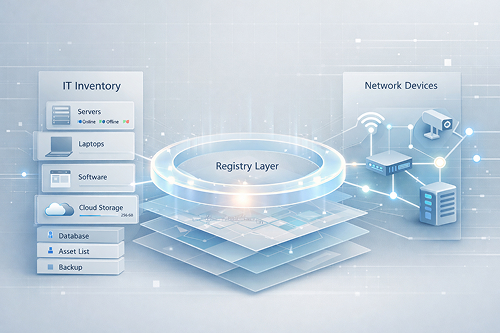
- IT Inventory: Assets that are formally registered, with defined ownership and lifecycle attributes
- Network Inventory: Assets that actively access the network and are visible within it
The challenge is that these two domains rarely align perfectly.
This misalignment is precisely why the concept of Network Access Registry (NAR) has emerged.
What Is IT Inventory?
IT inventory represents the formal record of all IT assets owned or managed by an organization.
It typically answers questions such as:
- Who owns this device?
- When was it acquired, and when will it be retired?
- Which department is responsible?
- What are its licensing, warranty, or maintenance details?
IT inventory is commonly managed through:
- CMDBs
- ITSM platforms
- ERP integrations
However, it is built on a critical assumption:
“This device is actively in use and located where it is supposed to be.”
In practice, this assumption is not always valid.
What Is Network Inventory?
Network inventory takes a fundamentally different perspective.
It focuses on questions such as:
- Which devices are currently accessing the network?
- Where, how, and how frequently are they connecting?
- Who is actually present on the network right now?
Network inventory is:
- Real-time
- Dynamic
- Concerned with access behavior rather than ownership or procurement data
As a result, a device may:
- Exist on the network without being recorded in IT inventory
- Exist in IT inventory but no longer appear on the network
This is where risk begins to materialize.
What Is Network Access Registry?
Network Access Registry is an approach designed to maintain a unique and verifiable record of all devices accessing the network.
Importantly, NAR is not a static list.
It is a control and reconciliation mechanism.
Its central question is simple yet critical:
“Are the devices accessing the network truly the same as those recorded in IT inventory?”
To answer this, the NAR approach:
- Accepts the network as the source of operational truth
- Continuously compares IT inventory against network reality
- Makes discrepancies visible and manageable
Why Must IT Inventory and Network Inventory Be Aligned?
The misalignment between these two inventories is not a theoretical concern—it introduces direct operational and security risks.
Risks When Alignment Is Missing
- Shadow IT: Unowned or unidentified devices gain network access
- Security blind spots: Security policies cannot be enforced on unregistered assets
- Audit challenges: Assets appear “on the list” but are no longer in active use
- Incident response issues: During an incident, the question “Who owns this device?” cannot be answered
In short:
- IT inventory describes what should exist
- Network inventory reveals what actually exists
Effective governance requires both.
How Does SPIDYA Network Access Registry Bridge This Gap?
SPIDYA Network Access Registry is designed to systematically manage the natural disconnect between IT inventory and network inventory.
SPIDYA NAR:
- Takes network-accessing devices as its reference point
- Compares these assets against existing IT inventory and CMDB records
- Clearly exposes mismatches and inconsistencies
- Enables these gaps to be resolved through defined processes
One point is critical:
SPIDYA NAR does not replace IT inventory systems.
Nor is it an alternative to network management tools.
It operates between these two domains, serving as a reconciliation layer.
Why Has This Approach Become Critical?
Modern enterprise networks now routinely include:
- Remote work environments
- BYOD policies
- IoT and OT devices
- Temporary and third-party access
In such environments:
- Relying solely on IT inventory creates blind spots
- Relying solely on network visibility lacks business context
The Network Access Registry approach unifies both perspectives within a single control plane.
Everything That Accesses the Network Must Be Managed
In corporate networks, risk does not stem from unknown devices alone, but from devices that are unknown, undefined, and unmatched.
Network Access Registry:
- Transforms inventory from a static record into a continuously validated process
- Provides a shared source of truth for security, operations, and audit teams
SPIDYA NAR is positioned to deliver exactly this shared reality.