






Self-Service IT: Can IT Manage Itself?
What is Zero Touch Automation?
Self-Service IT (Zero Touch Automation) means completing an IT process from start to finish without any human intervention. It is triggered, it runs, it concludes. No one clicks a button, no one waits for an email to provide approval, and no one is woken up in the middle of the night. This is exactly where it differs from classic IT automation. Automation speeds up a step. Zero Touch Automation eliminates that step entirely.
Does a user go to a self-service portal and reset their password? That is automation. Does the user forget their password, the system detects it, verifies their identity, resets it, and notifies the user—all without them touching anything else? That is Zero Touch.
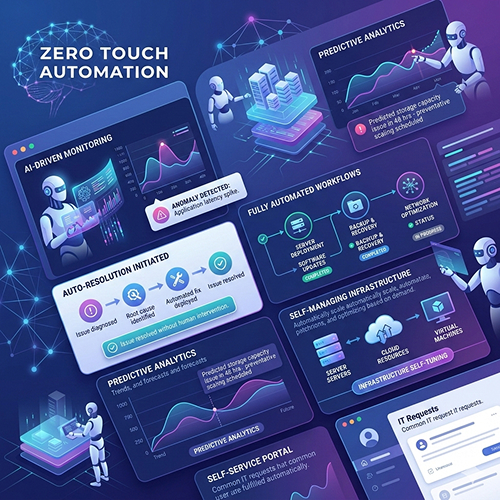
Zero Touch Automation with Examples from the IT Ecosystem
Self-Service IT may seem like an abstract concept, but it has very concrete applications in the field.
- Onboarding: When a new employee joins the company, the information entered into the HR system automatically acts as a trigger. The laptop is configured, required software is installed, an email account is opened, and access to relevant systems is granted. Not a single ticket reaches the IT team.
- Infrastructure Management: When a server’s disk usage exceeds a critical threshold, the monitoring system detects it instantly. An automatic cleanup script runs, space is cleared, and a report is sent to the relevant team. No one gets woken up at midnight.
- Offboarding: When an employee leaves the company, all system accesses are automatically revoked. No applications or accounts are left behind. The security team doesn’t have to lift a finger.
Why Is It So Important?
Because human intervention is both slow and prone to error. Even the most experienced technician gets tired, misses details, or makes mistakes in prioritization. Self-Service IT, however, applies the same standard every single time, regardless of the time of day or workload.
Furthermore, it provides a critical advantage in terms of scalability. Manual processes scale linearly: when the workload doubles, you need twice as many people. With Zero Touch systems, even if the workload increases tenfold, the same infrastructure handles it. As the company grows, opens new offices, or undergoes mergers and acquisitions, the automation is ready.
There is also a massive difference in terms of security and compliance. Every action is logged, and every step is documented. During audit processes, the answer to “who did what and when” is ready and waiting in the system. In manual processes, compiling this information can take days.
Which Technologies Make This Possible?
Zero Touch Automation is not achieved through a single tool. Orchestration platforms connect different systems and manage workflows. Monitoring tools act as triggers. IAM systems automatically execute identity and access operations. ITSM platforms record the entire process. Combining these tools correctly creates a true zero-touch experience.
How Is the Margin of Error Managed Without Human Intervention?
This is one of the most legitimate questions asked about Zero Touch Automation. The answer is: in ZTA systems, the margin of error is not corrected by humans; it is predicted and limited by the system.
There are several core mechanisms for this:
- Thresholds and Guardrails: Automation boundaries are pre-defined by humans: “If this condition occurs, do this; if it doesn’t, stop and open a ticket.” In essence, human intervention is pre-coded.
- Fallback Mechanisms: Every automation scenario has a “what if it fails?” plan. If the system cannot resolve an issue itself, a human is automatically brought into the loop—but this is an exception, not the rule.
- Continuous Logging: Since every step is recorded, any error can be instantly analyzed to answer “what happened, why, and when.”
- AI and Anomaly Detection: Modern ZTA systems use machine learning to detect unusual situations in advance and intervene before an error escalates.
The main takeaway here is: Zero Touch Automation does not mean “no humans,” it means “humans are not involved in routine tasks, only in exceptions.”
IT Teams Are Finally Freed from Meaningless Effort!
Self-Service IT is the next step in the evolution of IT operations. The goal is not to make technology more complex; on the contrary, it is to ensure that people can focus on what truly matters instead of getting bogged down by routine tasks.
If your IT team is still solving the same problems over and over again, a zero-touch approach is not just an efficiency tool—it is a strategic necessity.
Fill out the form for detailed information about IT Process Automation and get in touch with us!