






What Is Middleware? Types, Categories, and How It Works
What is middleware? Middleware is a software layer that sits between the client and the application—or between multiple applications—and is responsible for processing, routing, transforming, and controlling requests and responses.
The primary goal of middleware is to separate business logic from infrastructure-level and cross-cutting concerns such as security, logging, error handling, performance control, and observability. This can serve as the second answer to the question “What is middleware?”
Capabilities including authentication, authorization, logging, exception handling, rate limiting, caching, data validation, and monitoring are typically implemented at the middleware layer. By centralizing these concerns, middleware keeps application code cleaner, more maintainable, and easier to scale.
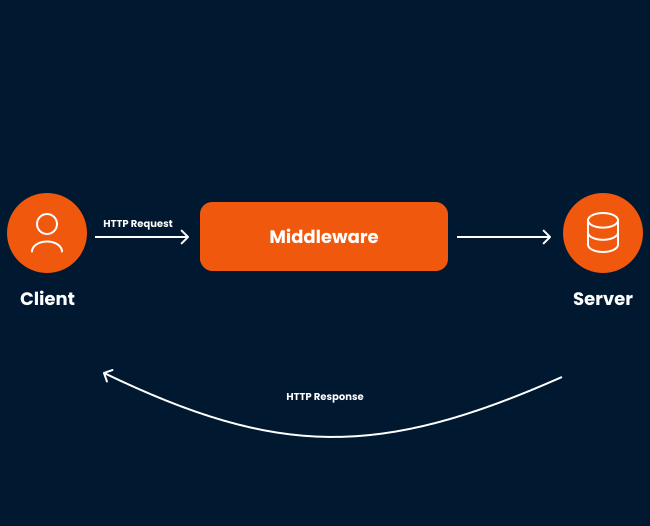
How Does the Request – Application – Response Flow Work?
In a typical web application, the request lifecycle progresses as follows:
-
Client → Request
A browser, mobile application, or another service sends an HTTP/HTTPS request. -
Middleware Pipeline
The request enters a predefined middleware pipeline. Each middleware component can:- Read the incoming request
- Modify request headers or payloads
- Terminate the request early (short-circuit)
- Pass control to the next middleware
-
Application / Controller / Handler
Business logic is executed, and communication with databases or external services occurs. -
Middleware (Response Phase)
As the response flows back, middleware components are invoked again for tasks such as response logging, header injection, compression, or metrics collection. -
Response → Client
The final response is returned to the client.
Middleware operates bidirectionally, observing and manipulating both requests and responses.
Where Is Middleware Located in the Architecture?
From a logical perspective, the middleware layer is positioned:
- Between the client and the application
- Between the web server (Nginx, IIS, Apache) and application code
- In front of or between services in microservice architectures
From a technical implementation standpoint:
- ASP.NET Core: Middleware runs inside the HTTP pipeline
- Node.js (Express / NestJS): Middleware exists in the request handler chain
- Java (Spring): Implemented as Filters, Interceptors, or Aspects
- API Gateways: Act as centralized middleware components
What Is the Relationship Between Middleware and Web APIs?
Web APIs are one of the most common environments where middleware is heavily used. This is because APIs are typically:
- Stateless
- Exposed to high traffic volumes
- Highly sensitive to security and performance issues
Middleware enables centralized and consistent control over:
- JWT / OAuth authentication
- API rate limiting and throttling
- Request and response logging
- Payload validation
- API versioning
- Exception handling
Without middleware, these concerns would need to be implemented repeatedly inside application logic, increasing complexity and risk.
What Does Middleware Look Like? (Technical Perspective)
Middleware is typically implemented as a function, class, or component, depending on the framework.
General execution model:
- Input: Request
- Processing: Control, transformation, monitoring
- Output: Response or next() invocation
The order of middleware execution is critical. Incorrect sequencing can result in security gaps, performance degradation, or incorrect responses.
Common Middleware Types and Responsibilities
1. Authentication and Authorization Middleware
- Token validation
- Role- and permission-based access control
2. Logging Middleware
- Request URL, headers, and payload
- Response status codes and execution duration
3. Error Handling Middleware
- Centralized exception capture
- Standardized error response formats
4. Performance and Timeout Middleware
- Request duration measurement
- Timeout enforcement
5. Rate Limiting and Throttling
- IP-based or user-based request limits
6. Caching Middleware
- Response caching
- Conditional requests (ETag, If-Modified-Since)
Why Is Monitoring Middleware Critical for Observability?
Because all inbound and outbound traffic passes through it, middleware is the most valuable observation point in modern architectures.
Key Components to Monitor at the Middleware Layer
-
Request Metrics
- Request count
- Request size
- HTTP method distribution
-
Response Metrics
- Status code ratios (2xx / 4xx / 5xx)
- Response payload size
-
Latency and Duration
- Average response time
- Percentiles (P95, P99)
-
Error Metrics
- Exception types
- Error rates
-
Throughput and Concurrency
- Requests per second
- Concurrent request volume
-
Dependency Metrics
- Database call latency
- External API response times
What Happens When Middleware Is Not Monitored?
1. Alert Fatigue
Real issues cannot be distinguished from temporary anomalies.
2. Ineffective Root Cause Analysis
It becomes unclear whether failures originate from the application, the network, or external dependencies.
3. SLA and SLO Violations
Latency spikes and error rates are detected too late.
4. Hidden Performance Bottlenecks
It is impossible to identify which middleware component is slowing down the request pipeline.
5. Increased Security Risk
Suspicious traffic, brute-force attempts, and API abuse remain undetected.
Modern Monitoring Approach: Middleware and Observability
In modern architectures, middleware is a primary producer of:
- Metrics
- Logs
- Traces
Platforms such as SolarWinds Observability, OpenTelemetry, Prometheus, and Grafana collect telemetry data directly from the middleware layer, enabling true end-to-end observability.
Conclusion
What is middleware? Middleware is the backbone of modern web and API architectures. When properly designed and monitored, a middleware layer enables applications that are:
- More secure
- Faster
- More resilient and scalable
Without monitoring, middleware quickly becomes one of the most critical blind spots in the system—hiding performance issues, security threats, and architectural weaknesses.